London gets a lot of attention (and many outside of London would argue too much attention), but as the capital it’s pretty hard to ignore – and it is a useful benchmark for comparison.
So we are going to be having a look at how London measures up against the rest of the South East.
The South East is typically quite a challenging area to develop due to the high proportion of AONBs, green belt and protected land – add in the thriving NIMBY scene and it can be difficult to push a project through.
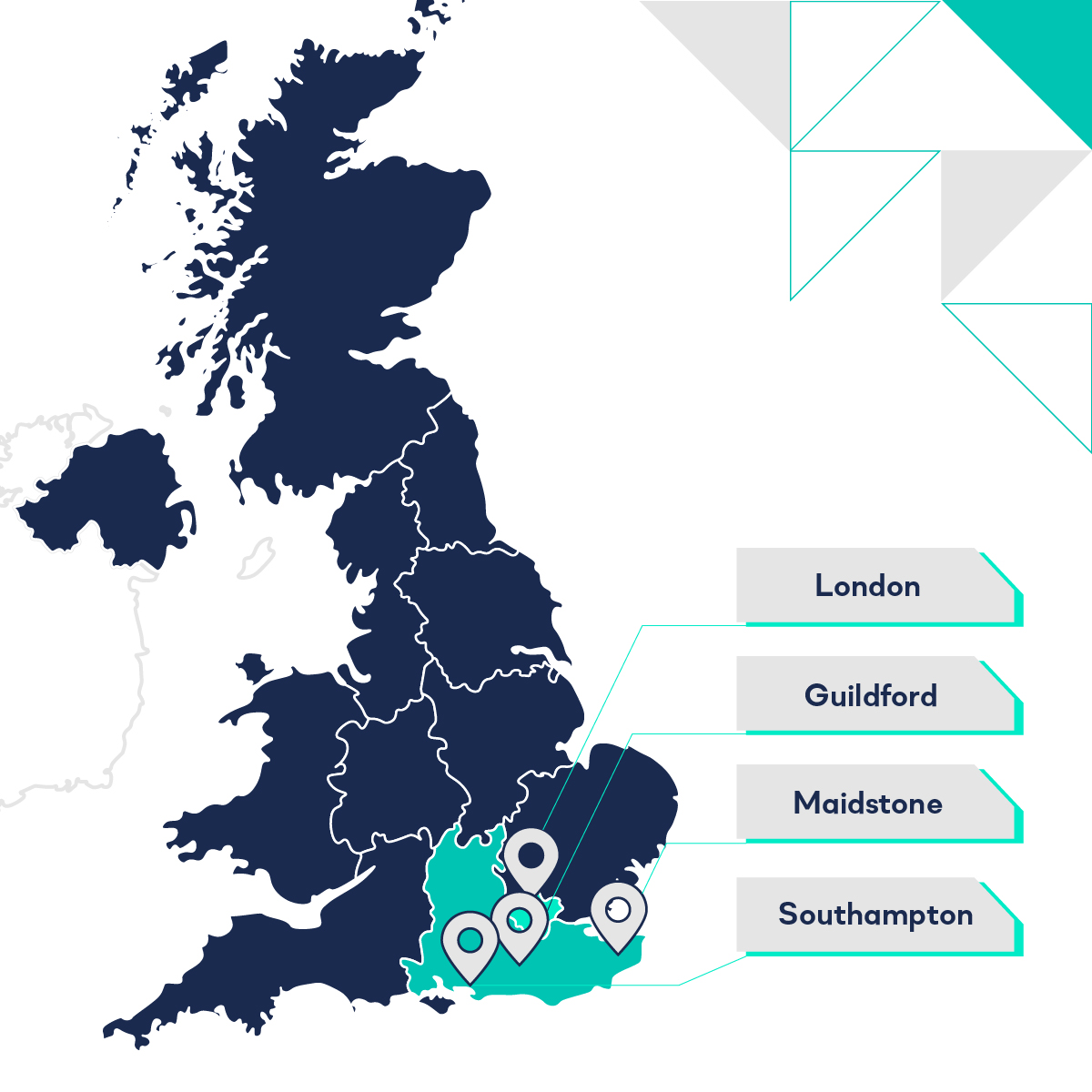
In this report, we’ll be looking at the housing market and demographic data for Guildford, Maidstone, Southampton, and London¹ – pinpointing key areas of opportunity for developers.
¹Data is inclusive of the local authority they are situated in, not just the city

People can hold the key to unlock insights into the property market. Analysing population density, migration patterns, median age and income can help you to make data-driven decisions about the type of properties that the local communities most need.
Guildford has the lowest population (150,352) and has a comparatively low number of people per sq km at 555. Guildford Council extends beyond the town and includes smaller villages, alongside greenfield and green belt land. Outside of the town centre, the population is relatively dispersed – accounting for the low average density.
Maidstone has the second lowest population (173,132) and the lowest number of people per sq km (440). Similar to Guildford, the town of Maidstone only makes up a small percentage of the local authority – with both local authorities containing large swathes of AONB land.
Southampton has a population of 252,872, but with a smaller area for a larger population, the density of inhabitants is much higher than with Guildford and Maidstone. Considering this, developers would need to be particularly cautious of space.
Unsurprisingly, London has the highest population of any city in the UK (9,002,488) and on average there are 5,727 people per sq km. To combat these space constraints, London is growing ever taller to create more housing in the city.
Net migration only focuses on population changes as a result of people moving in and out of the local authority area.
Guildford is the only local authority that had positive net internal and international migration. However, the numbers are quite small, with the population increasing by 1,823 people as a result of migration to the area in 2020.
Maidstone had a higher number of people moving to the area from other parts of England than those migrating internationally. The population decreased by 109 as a result of people leaving to live overseas versus the 1,205 increase as a result of domestic inflow in the last year. As the largest town in Kent (plus good transport links to London) more people may be leaving the capital for nearby commuter towns due to the recent increase in remote working.
Southampton had a negative net internal migration (-3,536) and a positive net international migration (+2,921).
As is common in large cities, there has been a lot of traffic in and out of London. Internally, net migration was -101,381, reflecting the large number of people who moved out of the city due to changing lifestyles and work routines brought about by the pandemic. However, there were still a lot of people moving into the city from outside of the UK with net international migration at 84,545.
Source: ONS
The median age for the South East is 41.9 so all the local authorities we’re looking at in this report come in below the regional average.
The median age for the inhabitants of Guildford is 37.1 reflecting its status as a commuter town for more established professionals and their families.
This is repeated in Maidstone, but the median age is even higher at 41.5.
Southampton has the lowest median age (32.3) out of the local authorities we’re covering in this report – coming in significantly below the regional average. Southampton is considered a lively and relatively affordable city for young people to live in – that, combined with the large university in the city, results in a low median age.
Greater London’s median age is 35.8, but there is a lot of fluctuation between boroughs so it’s worth delving deeper into the data for the specific areas you are targeting.
Source: ONS
Guildford has the highest median income (£41,668) – and the house prices to match, as we’ll see later on in the report. It is one of the most affluent authorities in one of the wealthiest regions, so developers have the freedom to edge over to the more expensive side of the scale when planning projects.
Maidstone’s income in 2020 was £32,533, experiencing a 36% increase since 2010.
Southampton has the lowest median income (£29,993) out of the four areas in this report, but saw a significant increase (46%) in the ten years leading up 2020.
Much like with median age, median income differs a lot across boroughs in London but the average for Greater London was £38,592.
London and the South East have some of the most expensive house prices in England and is a competitive market for developers. That being said, there’s the chance for developers to make large profits if they’re looking for the right opportunities in the right areas.

Despite an already-high baseline for properties in the South East, there’s been a significant increase in average house prices in some of the key areas we are looking at in this report – even exceeding the national average of 10.7% in England.
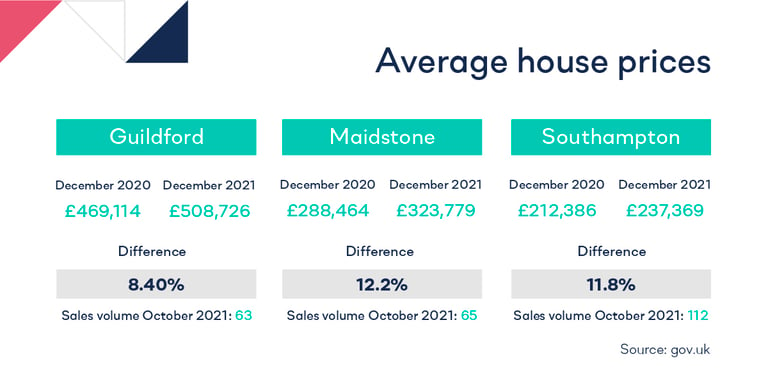
Out of the local authorities from this report, Guildford has the highest house prices by a significant margin (£508,726). Its close proximity to London, as well as an abundance of green spaces, makes it a desirable location for people with larger budgets.
Maidstone saw the biggest increase from December 2020 to December 2021 of 12.2%. This rise could be as a result of increased demand from the internal and international inflow of people moving to the area.
Southampton had a 11.8% increase in house prices – but still had the lowest average house price of the three areas in this report (£237,369).
As we can see from the areas we’ve looked at in this report, there’s a rough correlation between median income and house prices in the South East.
The data we have for London is slightly different and more detailed, as it’s calculated by borough, or inner versus outer London.
From the heatmap, we can see a clear pattern of median house prices being higher in inner and South West London. The Borough of Kensington and Chelsea had the highest median house prices in 2021 at £1,257,677. Westminster and Camden are not far behind at £900,000 and £785,000 respectively.
It’s not too surprising that theses three boroughs are ranked as the top three most expensive, as not only are they easily accessible to central London, but there’s a high proportion of constraints and protected buildings. House prices are high because demand is outstripping supply and there’s a lack of opportunity for developers to balance it out.
The far East and South of London had the lowest house prices in 2021, with Barking and Dagenham sitting at the bottom of the table (£325,000). Bexley (£390,000), Croydon (£414,340) and Sutton (£425,000) are also amongst some of the lowest priced boroughs.
It could be worth keeping an eye on these boroughs, particularly with the increased demand for larger, greener spaces just outside of central London.
If we zoom out a bit more we can take a look at the changes for median house prices in London from 2016 to 2021.
As expected, the prices in inner London are significantly higher than the outer boroughs, but as of 2021 the gap has been narrowing. This is most likely a result of the pandemic and the “race for space”, which saw many people leave central London to live in homes with gardens and surrounding nature.
It will be interesting to keep an eye on this trend to see if the gap widens again post-pandemic as young professionals gradually make their way back to the city for work and a faster pace of life.
In terms of sales volume for October 2021:
London is the clear winner with 1,993 homes being sold. This is not surprising when considering the total population and the huge inflow and outflow of people from the city. Guildford and Maidstone had very similar figures to each other sitting at 63 and 65 respectively. Southampton’s sales volume was nearly double theirs at 112.
As we saw above, the house prices in the South East are consistently some of the highest in the country – but what’s the price difference between new and existing properties?
We took a look at the price-per-square-foot data and calculated how much more (or less) new houses were being sold for in areas across the country. New-build premium is the percentage difference between new and existing property prices.
In 2021, Guildford saw a negative new-build premium of -3.28%, meaning that existing properties are selling for more than new builds.
In Southampton, however, new builds are generally more expensive with a 22.15% new-build premium.
Maidstone also has a positive new-build premium at 3.08%.
For London, we have a breakdown of the data for each individual borough in the city. Due to the high demand for housing in the capital, it’s unsurprising that there’s a higher proportion of boroughs with a positive new-build premium, such as Westminster (146.75%), Merton (60.15%) and Hammersmith and Fulham (54.5%). However, there are still pockets where new builds are selling for less than existing properties, such as Kensington and Chelsea (-50.51%), Richmond-upon-Thames (-20.56%) and Southwark (-9.65%).
Generally in areas outside of London, new-build properties are generating lower profit margins in the South East than they do in other parts of the country. This could be because the wrong type of new builds are being built in this region (driving down the prices) or inhabitants are more attracted to the more expensive (and logically the larger and more affluent) homes that have previously been on the market.
The South East is one of the worst-performing regions when it comes to meeting housing-delivery targets (the annual targets that each local authority is expected to achieve). In the data above, we show the number of houses delivered as a percentage of the target.
From 2018-2020, Guildford was consistently under target. However, they have been improving year on year, surpassing their target in 2021, achieving 144%. As mentioned previously, there is a lot of green space but large swathes of it are protected. Therefore, planning constraints and getting approval are the main challenges. A contrast to lack of space which has cropped up as a recurring hurdle with a lot of the local authorities we’ve looked at.
Maidstone has exceeded their housing delivery target for the last fours years, reaching 170% in 2021. This is even more of an accomplishment when looking at neighbouring local authorities – Maidstone is very much an island of green in a sea of missed housing targets.
Southampton also surpassed the figures they needed to reach, achieving 138% against their target in 2021 which was slightly down from the previous year. As a historic port city, there are more brownfield sites than other parts of the South East, which could make for profitable seafront developments.
Housing delivery targets for London are given on a borough-by-borough basis, with the majority under-achieving against their expected goals. South West and West London are performing the best, with boroughs like Croydon, Lambeth and Wandsworth beating their targets four consecutive years in a row.
Although Guildford, Southampton and Maidstone all built more houses than they were required to in 2018-2021, this is a rarity in the region and is still significantly lower than housing delivery in other regions, like the North West. It does, however, mark them out as areas of opportunity in a notoriously tough area to secure planning permission.
The South East has some of the highest proportions of Green Belt and protected land in the country. Largely due to the London Metropolitan Green Belt which cuts through most of the Home Counties.
Guildford in particular, is swathed in Green Belt land (83.5%) and has historically underperformed on housing targets as a result. However, in 2021 they achieved their target – perhaps as a result of the Action Plan they had to put in place in 2020 as a consequence of missed targets.
In Maidstone, there’s only 1.3% of Green Belt land, but the Kent Downs partially fall in the local authority meaning that 27.4% of land is protected. Sticking to their Local Plan and keeping it updated has meant that they are still able to deliver, despite the land limitations faced.
Southampton is pretty light on the protected land front (2.2%) and as a result have been significantly over target for the last four years.
The South East and London have some of the highest house prices and wealthiest inhabitants in the country – making it a potentially lucrative market if you’re able to get your projects through.
London is perhaps the most difficult place to find unused land, but sometimes under-used land can be enough. Parcelling together two or three under-used pieces of land into a land assembly can be a smart play in cities where available land is hard to come by.
Download our eBook – Identifying Opportunities: Land Assemblies – to find out more.
Much of the South East has the opposite problem – an abundance of land but a resistance to using it for housing. Between green belts and AONB, it can be hard to find unprotected land in Guildford and many other local authorities. However, with consistent misses to their housing delivery targets, the council may be urged to make more land available and open up more opportunities for developers.
There are also brownfield opportunities in some of the coastal cities in the South East, such as Southampton. So, it is worth checking the brownfield registers of local authorities in the region.
Whichever area of the South East that you want to concentrate your development efforts on, LandInsight can help you to source and assess off-market opportunities – giving you an edge over your competitors.
We’ll be updating this report whenever we have new data and we’ll let you know when new content is added.